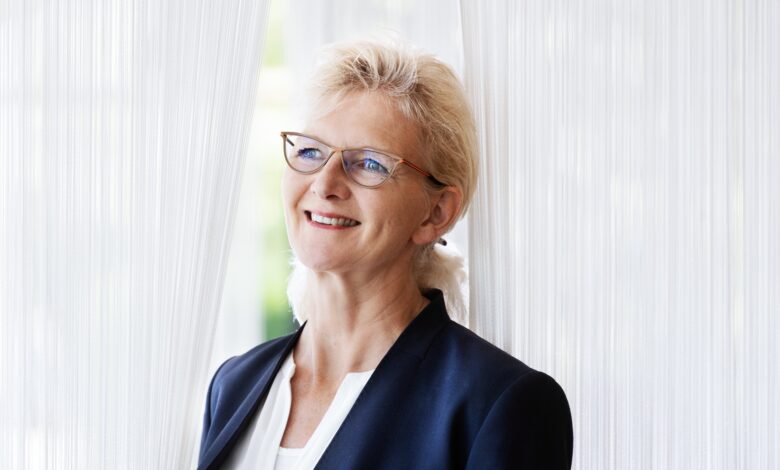
Meiny Prins, global CEO and co-owner of Priva, the Expo 2020 Champion at the Netherlands Pavilion and Ambassador of the Dutch Horticulture sector
In this week’s edition of ‘In Conversation with Successful Women Entrepreneurs’ we are in conversation with Meiny Prins, global CEO and co-owner of Priva. Prins is also the Expo 2020 Champion at the Netherlands Pavilion and Ambassador of the Dutch Horticulture sector.

Prins devotes a large part of her life to promoting sustainability, innovation and internationalization and is a much sought-after authority in this field. With her clear, inspirational message on sustainability, she bridges the gap between companies, governments and sectors. Having been named Businesswoman of the Year in 2009, receiving the and her the first CleanTech Star awarded by WWF (World Wide Fund for Nature) for Priva in the same year, and being acknowledged as an Influential Leader for sustainability by AACSB International, Meiny Prins also founded the Sustainable Urban Delta Foundation to inspire cities to re-think urban development by creating space for food production.
Meiny gets in conversation with Dubai Diaries and talks about sustainability, innovation and entrepreneurship. These are the qualities Priva stands fro and Meiny tells us what’s in store for its customers.
Dubai Diaries: Priva is the name when we talk about sustainability, innovation and entrepreneurship. How does Priva make these three work together?
Meiny Prins: At Priva our vision is to bring people, knowledge and technology together to contribute to a sustainable world where a growing population has access to safe and nutritious food.
To do that, we need to start with the entrepreneurs and support them. They will be the drivers of sustainable and disruptive solutions, and together we can create a sustainable food ecosystem.
Today, 7,000 billion USD is spent to keep a food production system alive that’s destroying our planet. As long as making profit and growing economies is more important than anything else, it will be difficult to make a change. We shouldn’t invest in a broken system but build one next to it, one that is driven by entrepreneurs and citizens.
We need to talk to entrepreneurs, inspire the next generation to work in agribusiness, and inform consumers so they can make good choices. There are so many ways in which we can support both entrepreneurs and consumers, but we need to do this now as there isn’t much time left. The climate change challenge is real now, not in 30 or 40 years from now, and in the quest for a sustainable and food-secure future it is important that we take action. We are the change together.
We opened our Middle East branch office in Dubai last year to become a global knowledge partner locally on the ground and to help achieve the region’s food security strategies and goals. Over the past months we have worked and continue to build bridges between companies, governments and sectors with the firm belief that business models for a sustainable and food-secure future are based on collaboration, knowledge sharing and the adoption of new technologies. In addition, we are committed to educating and exciting the next generation of growers in the Middle East and to make horticulture an attractive career path for young nationals across the region with a focus on innovation and technology, including Artificial Intelligence (AI) and robotics.
DD: What is Urban Delta foundation and how does it involve the big cities?
MP: The Sustainable Urban Delta foundation focuses on the importance and impact of food producing cities.
We now see that smaller farms in the surroundings of cities that produce vegetables, fruits, meat and fish for the people in those cities are disappearing They have no successors because the work is hard and the income low. A food strategy aimed at creating local food systems in a sustainable and integrated way will be a great opportunity to make food production attractive again for younger people.
This will draw younger generations that want to live close to or within urban areas, where they can develop a new economy around food production in which circularity and new technology will play a big role. Where they can build a future of a green, healthy and inclusive world.
The foundation was established to inspire megacities to make choices that open the door to healthy and sustainable urban growth. A crucial element of the approach is the production of local, healthy and fresh food. This can either be done inside cities or on undeveloped agricultural land surrounding cities, known as green belts. The Sustainable Urban Delta aims to be the catalyst and the connector to create a better future.
The Sustainable Urban Delta produced documentary on this topic which takes viewers on an eye-opening journey that shows how some of the most pressing challenges we face today can be solved by bringing sustainable food production back to the city. The trailer and full documentary can be watched via this link: https://sustainableurbandelta.com/documentary/. The second edition of the documentary is currently being filmed, including in the UAE last month.
DD: How would you, as representative of Priva, describe the cities of future?
MN: City governments, urban planners, developers and architects need to rethink the way cities are designed. I see cities of the future as food-producing cities that produce much of their own food and be the source of a sustainable future.
Food producing cities are livable cities; they create new connections on a social, ecological, and economic level, providing more green space, saving water, balancing energy sources, helping reduce carbon emission and thus contributing to a better climate.
Integrating food production not only ensures that megacities are self-sufficient, but also means that more green space is created, water can be saved, energy sources can be optimally utilized, while reducing CO2 emissions and thus making a substantial contribution to a better climate.
We need to bring green belts closer to the cities and develop the brown fields to create more space for food production in metropoles. This will also help in attracting the next generation of growers by bringing farms closer to the urban areas where they study, have their friends and want to live.
DD: Priva is working in more than 100 countries at the moment. Are all these developed countries? Do we have solution for under developed or developing countries?
MP: We currently have 18 offices around the world and work with more than 600 colleagues in over 100 countries. Through our international expansion we look to accelerate our growth and technology innovation. The breadth and depth of our solutions help address global challenges in climate change, water- and energy use and food security and at Priva we are committed to making a profound and positive impact on living, working and horticulture environments, including here in the Middle East.
Priva is committed to developing sustainable business models to help achieve countries’ self-sufficiency and food security strategies. Through our local presence on the ground, our team works alongside local entrepreneurs, farmers, investors and governments, to help create a sustainable food ecosystem.