If you want to understand the world economy right now, don’t start with a single headline number. Start with how people are planning: shorter budgets, tighter hiring decisions, and more “what if” conversations than “what’s next”. In early 2026, the global economy is still expanding, but it is doing so in a way that feels cautious — and for many, oddly personal.
According to the International Monetary Fund (IMF), global growth is projected at 3.3% in 2026 and 3.2% in 2027. The IMF’s diagnosis is telling: technology investment, supportive financial conditions and private-sector adaptability are helping to offset the drag from shifting trade policies.
That phrase “offset” does a lot of work. It implies the world is not running on one broad engine, but on competing forces that happen to balance out, for now. A strong technology and investment cycle is cushioning the impact of higher trade barriers and geopolitical uncertainty. It also means the economic mood can change quickly if one side of that equation weakens.
Central banks are a major reason the picture looks calmer than it did a year or two ago. In the United States, the Federal Reserve’s January 2026 statement kept the federal funds target range at 3.5% to 3.75%, and stressed a data-led approach to any further adjustments. In Britain, the Bank of England held Bank Rate at 3.75% in February after a close vote that reflected how finely balanced the debate has become. In the euro zone, the European Central Bank’s February decision left rates unchanged, including a deposit facility rate of 2.00%.
Rates may no longer be rising in the way they were, but money still has weight. High borrowing costs continue to shape investment plans, refinancing timelines and the housing markets that sit behind consumer confidence. Lower inflation helps, yet it does not instantly restore the sense of ease many households and smaller businesses associate with “good times”.
If monetary policy is the stabiliser, trade policy is the irritant — and sometimes the accelerant. The World Bank’s Global Monthly report (January 2026) argues that growth held up better than expected even after trade tensions escalated, partly because companies adapted and because investment remained firm. Then it points to a more uncomfortable dynamic: trade was also propped up by “front-loading” — firms bringing imports forward ahead of tariff changes, stockpiling to protect themselves from rules that could change mid-year.
The same World Bank report estimates that by late 2025 the average effective U.S. tariff rate was about 17%, a level it describes as the highest since the 1930s aside from a brief spike earlier in the year. That is not just a political statistic. It is a business reality that encourages redundancy over efficiency, and caution over long-term commitments.
The IMF expects this trade friction to show up in the global totals. In its January 2026 WEO Update text, it forecasts world trade volume growth slowing from 4.1% in 2025 to 2.6% in 2026. Slower trade is not automatically a recession signal, but it does make growth more dependent on domestic demand and on a narrower set of investment themes.
One of those themes is now impossible to ignore: the technology build-out behind AI. The IMF explicitly highlights technology investment as a key offset to trade headwinds — and you can see that logic in countries that are feeling the upside. In Singapore, Reuters reported on 10 February that the government upgraded its 2026 growth forecast to 2% to 4%, citing strong global conditions and demand linked to AI-related investment, with manufacturing and trade-related services expected to benefit.
This matters because the AI story is not only about software. It is about concrete infrastructure: data centres, chips, power capacity, networks, and the security and governance needed to run them at scale. That kind of spending can support jobs and demand even when other parts of the economy are hesitant. It also creates a new sensitivity: when a large share of confidence leans on one investment wave, markets become more alert to any hint that the returns are arriving slower than hoped.
Energy is another source of that sensitivity, especially because it can turn geopolitical risk into inflation risk almost overnight. On the forecast side, the U.S. Energy Information Administration (EIA) expects Brent to average $56 a barrel in 2026, down from an average of $69 in 2025, as global oil production is projected to exceed demand and inventories rise.
On the real-time side, prices can still be pulled higher by fear. On 10 February, Reuters reported that Brent was trading near $68.9 as traders weighed supply risks linked to U.S.–Iran tensions, after U.S. maritime guidance highlighted security concerns around the Strait of Hormuz — a route for roughly a fifth of global oil transit.
Europe’s story adds another layer. Inflation has eased, but policymakers are wary of reacting to short-term dips. The ECB’s president, Christine Lagarde, told European lawmakers that inflation is expected to stabilise at the ECB’s target in the medium term, while emphasising uncertainty and a meeting-by-meeting approach. Meanwhile, Bundesbank president Joachim Nagel argued that the ECB’s current stance remains appropriate even after inflation dipped, a reminder that central banks are still guarding against second-round shocks as well as weak growth.
Taken together, these threads explain why the global economy can look healthy and anxious at the same time. Growth is steady enough to keep unemployment from surging in many places. Inflation is easing enough to give central banks room to pause. Yet the foundations are being reconfigured: trade is less predictable, supply chains are more political, and investment is increasingly concentrated around technologies that promise big productivity gains but require huge upfront spending.
What this means for the GCC
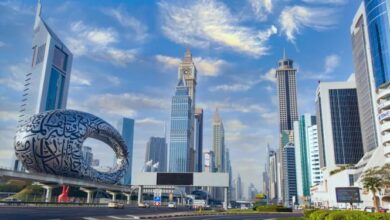
For the Gulf, this global mix lands less as a distant macro story and more as a set of levers that move real decisions, from energy revenues and infrastructure spending to trade flows, investment appetite and consumer confidence. The region’s position as a logistics and services hub gives it advantage when companies reroute supply chains, but it also means GCC economies feel the churn of trade policy shifts quickly, sometimes before it shows up in official data.
According to the World Bank, growth across the GCC is projected to accelerate to around 4.5% in 2026, driven by the expected easing of OPEC+ production cuts and continued strength in non‑oil sectors. That is an important detail: it suggests the region’s 2026 story is not only about oil volumes, but about whether tourism, finance, technology and industry can keep expanding even if global demand wobbles.
The World Bank’s Gulf Economic Update has pointed to structural reforms and rapid digital innovation as supports for momentum across the board. In the UAE, diversification is also showing up in the plumbing of finance: Reuters reported that Dubai’s DIFC saw new registrations rise by nearly 40% in 2025, reflecting how global firms are using the Gulf as a base for capital, talent and regional operations.
That said, the GCC is not insulated from tighter global financial conditions. With several currencies pegged to the U.S. dollar, interest-rate settings in the United States still shape borrowing costs locally, and global risk sentiment can still switch quickly when energy geopolitics flares. The GCC’s advantage in 2026 will be its ability to turn today’s inflows and investment cycles, including the infrastructure build‑out behind AI, into durable, non‑oil growth that outlasts the next external shock.
The credibility test for 2026 is whether resilience becomes more evenly shared. If the AI investment cycle spreads into measurable productivity beyond the technology sector, if trade rules become more predictable, and if energy shocks remain contained, confidence can return in a way that lasts. If those conditions fail, the world may still grow, but it will do so with tight margins, short planning horizons, and a permanent sensitivity to the next policy headline.