LIVE – April 06: Iran Warns Fuel will be Cut Off ‘For Years’ if Trump Carries Out Threat

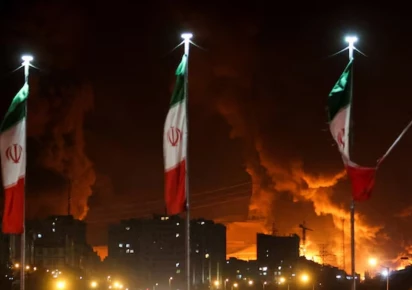
Iran’s paramilitary Revolutionary Guard warned Tuesday it would “deprive the U.S and its allies of the region’s oil and gas for years” if U.S. President Donald Trump carries out his threat to attack power plants and bridges if the Strait of Hormuz doesn’t open.
Multiple Iranian media outlets carried the statement.
It also issued a new threat to the Gulf Arab states.
“We have exercised great restraint and had considerations in choosing retaliatory targets, but from now on all these considerations have been removed,” the warning read.
Container ship hit in Persian Gulf
A container ship in the Persian Gulf has been hit by a projectile that caused damage, the British military said Tuesday.
The attack happened in international waters south of Iran’s Kish Island, the British military’s United Kingdom Maritime Trade Operations center said.
It said no one was hurt and there was no environmental impact from the apparent attack.
Over 20 ships have been attacked in the Mideast by Iran since the war began.
At least 4 Italian airports impose jet fuel restrictions
At least four northern Italian airports have imposed restrictions on jet fuel due to shortages, giving priority to long-haul and medical flights.
The restrictions at Milan Linate, Bologna, Venice and Treviso airports involve supplier Air Bp Italia, the British Petroleum group’s aviation division, and will remain until at least April 9.
Priority will be given to ambulance flights, state flights and flights of more than three hours, according to an official notice.
For nonpriority flights, the airports have imposed a supply ceiling of 2,000 liters (528 gallons) per aircraft.
The Venice airport has requested pilots ensure they have enough fuel from the previous airport for the following flight.
France dispatches fuel trucks as stations run dry
Nearly 1-in-5 service stations in France had run dry of at least one type of fuel Tuesday morning as motorists filled tanks after Easter weekend.
There is no risk of broader fuel shortages and “oil is arriving in France,” government spokeswoman Maud Bregeon said, adding that shortages at some pumps resulted from transport difficulties that were being urgently addressed.
Around 18% of service stations were short of at least one fuel type, but 83% of those belong to TotalEnergies, which has capped prices. Weekend lines formed at some of the company’s stations because its fuels are often cheaper than other distributors.
Bregeon said about 900 trucks, hundreds more than a normal day, were traveling to Total stations with resupplies Tuesday.
“There are no problems at the refineries. When trucks go to depots, they can load up” with unleaded and diesel, Bregeon said. “We can expect a progressive improvement.”
King Fahd Causeway reopens after attack threats
The King Fahd Causeway, a key bridge linking Saudi Arabia and the island of Bahrain, reopened Tuesday morning after closing for hours over possible threats from Iran.
The King Fahd Causeway Authority made the announcement in a post on X, saying the only route by road between Bahrain and the Arabian Peninsula reopened.
Bahrain’s airport has been closed over the Iranian attacks for weeks.
The hourslong closure came after a ballistic missile attack from Iran targeted Saudi Arabia and may have done damage to energy infrastructure there.
The kingdom has not elaborated on damage from that attack.
Pakistan and Egypt urge de-escalation as Trump deadline nears
Pakistan Foreign Minister Ishaq Dar spoke early Tuesday with Egyptian Foreign Minister Badr Abdelatty about the latest regional developments in the face of an approaching deadline for the opening of the Strait of Hormuz set by U.S. President Donald Trump.
Pakistan’s Ministry of Foreign Affairs said the leaders “underscored the need for de-escalation and dialogue” and agreed to remain closely engaged as the situation evolves.
Pakistan, with the support of regional countries, has been engaged in diplomatic efforts to bring the U.S. and Iran to the negotiating table.
Abdelatty also spoke with U.S. envoy Steve Witkoff and Iraqi Foreign Minister Fouad Hussein.
The calls included “an assessment of the rapidly evolving situation and the efforts … to reach understandings between the U.S. and Iran to achieve de-escalation and reduce tensions,” the Egyptian foreign ministry said.
WHO suspends Gaza medical evacuations after contractor killed
The United Nations health agency has suspended evacuations from the Gaza Strip through the Rafah Crossing with Egypt after the death of one of its contractors.
World Health Organization Director-General Tedros Adhanom Ghebreyesus said in a social media post that the contractor was killed Monday in what he described as a “security incident.”
Two WHO staffers were present but were not hurt, he said without elaborating.
The incident is being investigated and the evacuations of patients and wounded people will be halted until further notice, Tedros said.
The Rafah Crossing was reopened in February after long delays in a key but mostly symbolic step in the Israel-Hamas ceasefire deal.
Iran general says: ‘Moms, dads, at night send your kids to man checkpoints’
A Revolutionary Guard general in Iran has urged parents to “send your kids to man checkpoints.”
Gen. Hossein Yekta, previously identified as leading plainclothes units of the all-volunteer Basij force, made the comments on an Iranian state television channel.
“Moms, dads, take your kids hands and go out on streets,” he said. “Do you want your kid to become a real man? Let him feel like a hero standing right at the heart of the battlefield. Moms, dads, at night send your kids to man checkpoints. They become men!”
Basij checkpoints have been repeatedly targeted in airstrikes.
The Basij has been accepting children as young as 12 to man checkpoints. Amnesty International has warned some even carry firearms, calling their recruitment a war crime.
During nationwide protests in January, Yekta warned parents to keep their children home or they would be shot.
Synagogue damaged in airstrike in Iran’s capital
Iranian media reported Tuesday that a synagogue in the capital, Tehran, was damaged in an airstrike.
They identified the house of worship as the Rafi Niya Synagogue.
Video from the site showed rescuers moving around and what looked like a book of Hebrew scripture in the rubble.
Iran has a small Jewish population still living in the country. Many fled during the 1979 Islamic Revolution.
Saudi Arabia acknowledges ‘debris’ falls near energy infrastructure
Saudi Arabia said early Tuesday that seven ballistic missiles from Iran targeted the kingdom’s oil-rich Eastern Province, with “debris from the missiles” crashing into the ground near energy facilities.
The brief statement from Maj. Gen. Turki al-Malki, a spokesman for the Saudi military, did not elaborate on the extent of the damage on the ground, though he said an “assessment is underway.”
It wasn’t clear what energies facilities had been impacted.
Malaysian commercial vessel allowed to pass in Strait of Hormuz
Malaysia’s Foreign Ministry said Tuesday that one of seven Malaysian commercial vessels stranded in the Strait of Hormuz has been allowed to pass and is now heading to its destination.
The ministry said this followed diplomatic talks with Iranian officials led by Malaysian Prime Minister Anwar Ibrahim. It didn’t give further details.
Malaysia reaffirmed its support for safe and open sea routes under international law, the Foreign Ministry said in a statement.
It called for continued dialogue to maintain peace and stability in the region.
Japan says a Japanese national who had been detained in Iran has been released
Japan said Tuesday a Japanese national who had been detained in Iran since January has been released on bail.
Chief Cabinet Secretary Minoru Kihara told reporters in Tokyo that his release was confirmed Monday and that Japan is demanding a full release from Iranian authorities.
He said the Japanese ambassador to Iran met the person released and that he was in good health without providing further details.
The person is believed to be a journalist at Japan’s NHK public television.
Another Japanese national, who was detained in Iran last June, was released and returned to Japan in March.
Iran official calls for youths to form human chains around power plants ahead of threatened Trump strikes
An Iranian official early Tuesday issued a video message calling on youths of the Islamic Republic to form “human chains” around power plants in the country ahead of threatened strikes by U.S. President Donald
Alireza Rahimi, identified by Iranian state television as the secretary of the Supreme Council of Youth and Adolescents, issued the video call in a newscast.
“I invite all young people, athletes, artists, students and university students and their professors,” he said.
Gather “Tuesday at 2 p.m. around the power plants that are our national assets and capital, regardless of any taste or political viewpoint, belong to the future of Iran and to the Iranian youth.”
Iran has formed human-chain demonstrations, also known as human shields, in the past around its nuclear sites at times of heightened tensions with the West.
Iraqi dictator Saddam Hussein’s had similar human-shield demonstrations during the 1991 Gulf War. He also dispersed foreign nationals held by his security services to possible targets of the U.S.-led campaign during the war.
UN to vote Tuesday on watered-down resolution on Strait of Hormuz
The U.N. Security Council scheduled a vote Tuesday on a resolution aimed at reopening the Strait of Hormuz that was watered down for a second time because of opposition from Russia and China.
The original Bahrain-sponsored resolution would have authorized countries to use “all necessary means” – U.N. language that can include military action – to ensure transit through the vital waterway, which Iran has largely blocked, and deter attempts to close it.
The sixth revision of the initial text that will be voted on only “strongly encourages” countries using the Strait of Hormuz to coordinate defensive efforts to contribute to safe navigation in the strait.
It says this should include escorting merchant and commercial vessels, and deterring attempts to close, obstruct or interfere with international navigation through the strait.
The vote is scheduled at 11a.m. EDT, hours before an 8 p.m. EDT deadline set by Trump for Iran to open the strategic waterway, where one-fifth of the world’s oil normally passes, or face attacks on its power plants and bridges.
Trump says it would take 4 hours to destroy Iran’s bridges and power plants
The president described the consequences that Iran would face if it doesn’t reach a deal with the U.S. by Trump’s 8 p.m. Tuesday deadline.
“We have a plan, because of the power of our military, where every bridge in Iran will be decimated by 12 o’clock tomorrow night,” Trump said during his Monday news conference.
Power plants in Iran, he continued would be “burning, exploding and never to be used again.”
Trump refused to say whether any civilian targets would be off limits in the U.S. response.
Source: AP news