MOCCAE and RECAPP by Veolia sign agreement to boost cooperation and increase collection rate of recyclables in UAE

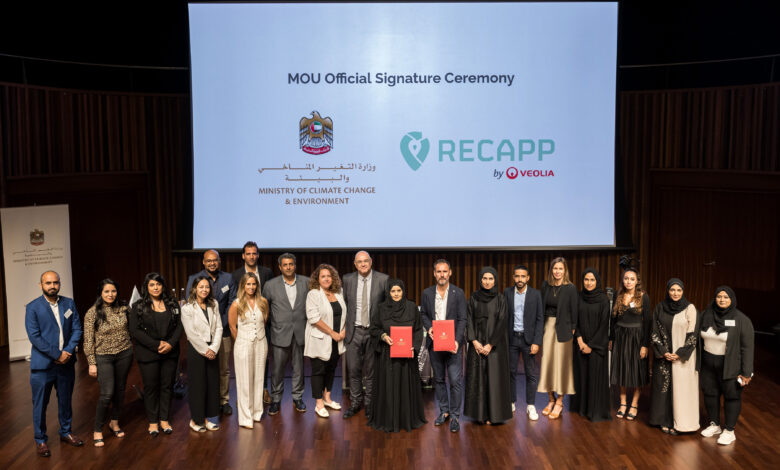
The UAE Ministry of Climate Change and Environment (MOCCAE) has signed a Memorandum of Understanding (MoU) with RECAPP, Veolia’s digital recycling solution for individuals and businesses, to enhance cooperation between the Ministry and RECAPP, and help provide education and awareness in the UAE for sustainable waste management practices.
The MoU was signed by Her Excellency Othaibah Saeed AlQaydi, Acting Assistant Undersecretary of Sustainable Communities Sector – Municipal Affairs, at UAE Ministry of Climate Change and Environment and Jérôme Viricel, General Manager of RECAPP by Veolia, at a recent ceremony held at Expo City Dubai. The collaboration will support the awareness campaign run by RECAPP to improve segregation at source for individuals, businesses and schools, with an aim to increase the collection rate of recyclables, and divert waste from landfills. The partnership will also promote waste segregation across communities and help build a sustainable and local circular economy in the UAE.
Commenting on the partnership, HE Othaibah Saeed AlQaydi, Acting Assistant Undersecretary of Sustainable Communities Sector – Municipal Affairs, at UAE Ministry of Climate Change and Environment, said: “The Ministry of Climate Change and Environment is proud to engage with RECAPP to speed up the adoption of the circular economy across the UAE. This agreement marks an important milestone in providing education and raising awareness in the UAE for sustainable waste management practices. Businesses and individuals will certainly benefit from the pioneering digital solutions provided by RECAPP to reduce and recycle waste as well as segregate any waste material generated instead of sending it to the landfill. Building a culture of recycling requires everyone to play an integral part, and we are confident that this agreement will provide the tools to engage the entire community in the UAE’s sustainable development in keeping with its Net Zero by 2050 strategic initiative and its Circular Economy Policy.”
Jérôme Viricel, General Manager of RECAPP by Veolia added: “On the occasion of the third anniversary of RECAPP, we are delighted to sign this Memorandum of Understanding with the UAE Ministry of Climate Change and Environment to bolster joint action to preserve our environment and promote sustainable consumption. Signed in the UAE’s Year of Sustainability, this partnership is based on the shared vision of RECAPP and MOCCAE to promote ecological transformation. I am confident that this partnership will raise further awareness for individuals and businesses to responsibly dispose of their waste and significantly boost the collection rate of recyclables – thereby adding fresh momentum to the UAE’s burgeoning circular economy as it prepares to welcome the world to COP28.”
During the ceremony, RECAPP also announced the launch of their new deposit scheme, the Smart Box – an AI-powered recycling box for plastic bottles, e-waste, perfume bottles, cosmetic products, sports accessories, garments and more. The MoU ceremony also demonstrated the benefits of RECAPP’s Reverse Vending Machines (RVM) and Smart Deposit Machine (RSDM) which provide an instant recycling solution for all types of plastic bottles, cans, tins, and canisters.
Working in collaboration with its rewards partners, in just three years of operations, RECAPP has managed to raise the volume of collections from 2.7 kg per collection in 2021 to 6.1 kg per collection in 2023. It has provided 86,000 vouchers as part of the Community Rewards on the app, while more than 150 offices and companies have registered for the app during the past three years.