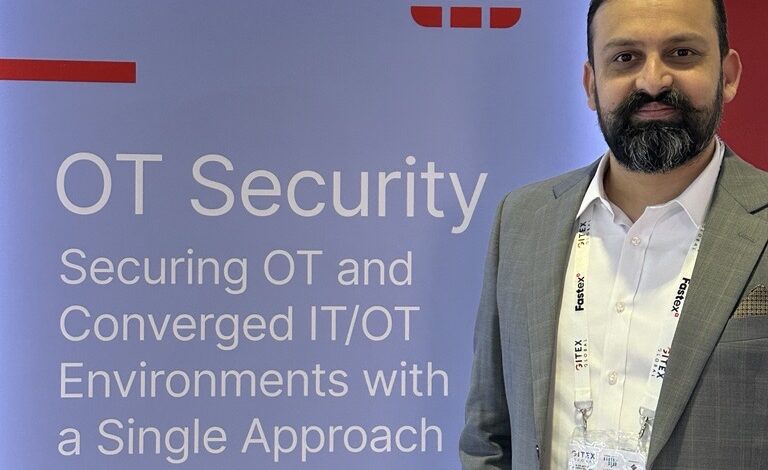
By: Fahad Faisal, Senior Business Development Manager for OT Security at Fortinet.
Introduction
Rail in the United Arab Emirates is entering an important new phase. New digital systems are being introduced across signaling, control, telecoms, operations and passenger services, creating a connected network that must be secure, reliable and resilient from the start.
As new rail services continue to expand in the UAE, cyber risk increasingly intersects with core train control systems, making robust security more important than ever. As the network grows, it becomes critical to build security into decisions from the outset rather than adding it afterwards.
Cybersecurity should no longer be viewed solely as an IT or compliance function. It has become a core operational resilience capability that directly supports safety, service availability and passenger confidence. As rail systems continue to converge across IT, OT and communications, security must be embedded into engineering, operations and lifecycle management from the outset rather than introduced as an afterthought.
Why Cybersecurity Matters in Rail
A cyber incident can affect the movement and reliability of a train carrying thousands of passengers, trigger network-wide disruption, lead to loss of revenue and potential regulatory penalties and affect service continuity across a broad network of trains and signaling systems.
Across the rail sector globally, cyber incidents and software vulnerabilities have shown that the risk is no longer theoretical. The threat environment includes DDoS attacks, ransomware, exploitation of protocol flaws and other attempts to disrupt operations or gain access to critical systems.
The systems needed to deliver dependable train services are highly interconnected and subject to multiple weak points. The most significant challenges are those that are specific to rail: segmentation, remote access, supply-chain trust, weakness in protocols, telecom migration, and incident detection and response. Rail operators in the UAE need to secure their infrastructure and ensure that systems are planned and operated in line with national information assurance expectations and recognized international standards.
Threat actors are increasingly leveraging AI-assisted techniques to accelerate reconnaissance, automate vulnerability discovery and enhance phishing and social engineering. Insider threats and compromised engineering workstations remain equally significant risks.
Nine Cybersecurity Priorities for Rail Operators
The rail sector already understands risk, safety, and the need for operational resilience better than most. The challenge is to apply that mindset to a complex and unpredictable cyber environment.
1 – Managing a Converged IT/OT Landscape
Rail systems span corporate IT, operational control environments, onboard train systems, and multiple customer-facing services. Opportunities for potential compromise increase as these disparate systems become more connected. Rail operators need visibility across the whole estate and must manage risk across both IT and OT environments. Guidance from NIST and other industry bodies stresses that OT security must account for operational continuity and safety constraints, not just data confidentiality. Treating IT and OT under one risk view helps ensure that security decisions support safe, reliable operations as the network expands.
2 – Securing Legacy, Long-life Assets
Railway technology can remain in service for decades and many systems were never built with cybersecurity in mind. The result is weaker native authentication, limited patching windows, and unsupported legacy components. Infrastructure needs to be protected through segmentation, monitoring, and risk-based controls as modernization programs continue.
At the same time, procurement and contracts for new rolling stock, signaling systems and operational platforms should reflect a secure by design approach, with clear cybersecurity expectations across the lifecycle, including patching, monitoring and incident response. This helps ensure that long-life assets coming into service today remain robust against evolving threats tomorrow.
3 – Coupling Safety and Security
Security controls that are normal in an enterprise environment can introduce latency, instability, or certification impacts in critical signaling and operational environments. Risk treatment needs care and precise, ongoing testing. Security controls need to be adapted to account for railway-specific operating conditions.
Significant cybersecurity changes in operational environments should be treated as safety-relevant decisions, with engineering, safety, operations and security teams all involved before new controls go live. This supports safe operations and reinforces a culture where cyber risk is considered alongside traditional safety concerns.
4 – Supply Chain and Third-party Exposure
Rail operators rely on a wide ecosystem of suppliers, including rolling stock manufacturers, signaling suppliers, telecom providers, integrators, and maintenance teams. NIST has identified supply chain security as a critical OT issue for the sector.
This risk is amplified because operators often do not have full control of embedded software, maintenance tooling, or update lifecycles across their complex estates.
Embedding clear cybersecurity expectations into contracts, controlling remote access for partners and maintaining active oversight of supplier risk all help reduce exposure across the rail system. In the UAE context, these measures support secure by design outcomes by making resilience part of how assets and services are procured and managed.
5 – Remote and Field Connectivity Pathways
Maintenance and diagnostic access to a wide geographically distributed network is essential to maintaining operations but also represents multiple intrusion pathways. These access points can be secured by strengthening identity controls, managing third-party access rights and segmentation, and applying session governance. Industry guidance advises a strong focus on cyber risk management practices because these pathways are difficult to secure consistently.
For rail in the UAE, strong identity checks, sensible segmentation and clear rules for remote work help ensure that field connectivity supports reliability without opening unnecessary doors. A consistent approach to logging and reviewing remote activity also supports incident reporting and learning across the network.
6 – Telecom Transformation
Rail operators are moving toward next-generation telecom architectures such as FRMCS. FRMCS introduces high-bandwidth, IP-based communications that enable more advanced, data-driven operations but also expand the attack surface and introduce complexity around identity, virtualization, and network oversight.
Designing these environments with security and resilience in mind from the outset, encrypting critical traffic, enforcing strong authentication and keeping clear separation between control communications and other services, helps reduce avoidable risk later and supports a secure by design posture across telecoms and signalling.
7 – The Threat Environment
Threat activity targeting transport continues to grow, and rail is considered strategic infrastructure. Operators must be prepared for a broad range of threats, including sophisticated attacks from nation states. The threat environment includes DDoS attacks, ransomware, exploitation of protocol flaws and other attempts to disrupt operations or gain access to critical systems.
Resilience requires more than technology. It means regular exercises, clear incident processes and open sharing of insights on emerging threats, rather than treating cybersecurity as an isolated technical issue. Developing an incident reporting and learning culture for UAE rail, where cyber incidents and near-misses are recorded, analyzed and shared in a structured way, will help the sector understand trends and act on lessons learned.
8 – Detection and Response
Aggressive scanning and containment actions can disrupt OT operations and create safety risks. Generic SOC playbooks are not appropriate for railway OT, so monitoring must be passive, context-aware, and designed to preserve safe degraded operations. NIST guidance highlights the importance of sector-specific security practices.
For rail operators in the UAE, detection and response should be tailored to rail operations and integrated across security, engineering and operations teams. Clear, sector‑specific procedures help ensure that incidents are managed quickly and calmly, while keeping trains running as safely as possible. Over time, building capability and skills at the intersection of rail and cyber will help operators respond more confidently and consistently.
9 – Fragmented Governance and Regulations
Cyber risk responsibility does not sit within one division: it spans engineering, operations, telecom, safety and leadership teams. Operators must ensure these functions work together to build a shared, coordinated ownership of risk. Rail and cybersecurity authorities increasingly emphasize the need to connect rail safety and cyber frameworks. This frames one of the sector’s challenges: security ownership is distributed, while risk is systematic.
In the UAE, strengthening governance also means deepening public–private collaboration: bringing together national cyber bodies, infrastructure owners, technology suppliers and operators to share information, align standards and develop sector‑specific resilience working groups across transport and other critical national infrastructure. These working groups can coordinate risk assessment, run joint exercises and support a more unified approach to resilience across rail and the wider economy.
A Unified Vision for Security
Cybersecurity in rail is about managing risk across a complicated and interconnected environment, while keeping trains running safely and on time. A focus on resilience, secure decision‑making and collaboration across the ecosystem will help UAE rail operators protect passengers and freight as the network grows.
Fortinet works with rail organizations around the world to protect operational and information systems and simplify regulatory compliance. Backed by expert training, deployment, and lifecycle support, Fortinet helps rail operators to modernize and future proof securely.