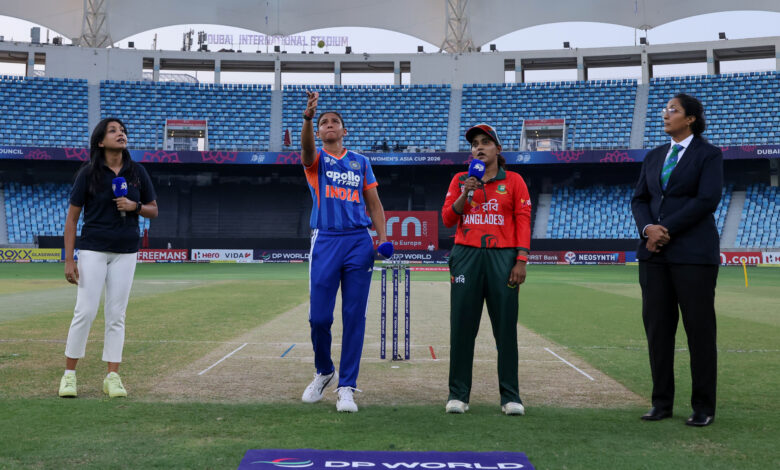
Bangladesh captain Nigar Sultana won the toss and elected to field against India in the first semi-final of the DP World Women’s Asia Cup at Dubai International Stadium on Thursday.
The decision gives Bangladesh the opportunity to use the slightly fresher surface and place early pressure on India’s powerful opening pair of Smriti Mandhana and Shafali Verma. It also allows them to chase later in the evening, when dew could make gripping the ball more difficult for India’s spinners.
The pitch appears firm but dry, with some grass visible on the surface. The new ball should come on to the bat, although scoring is expected to become more difficult as the match progresses. The surface has assisted spin during the tournament, making strike rotation important through the middle overs. A first-innings score of around 145 to 155 could be competitive, although India have already shown they can go well beyond that if Mandhana and Shafali settle early.
India enter the knockout match as clear favourites after winning all three of their group games. Bangladesh finished second in Group B, securing their place in the last four with a 34-run victory over hosts UAE.
The winners will face either defending champions Sri Lanka or Pakistan in Sunday’s final.
India topped Group A with six points and a net run rate of +5.471, the best of any team in the competition. They defeated Thailand, recorded a 137-run victory over Hong Kong, China and bowled Pakistan out for just 55.
Bangladesh’s route to the semi-final was less comfortable. They beat Indonesia and UAE but lost to Sri Lanka, finishing behind the defending champions in Group B.
However, knockout cricket has previously brought out the best in Bangladesh against India.
They famously defeated India in the 2018 Women’s Asia Cup final to claim their only title. Bangladesh beat India twice during that tournament, including in the group stage, and those remain two of the biggest results in the country’s cricket history.
The overall record remains heavily in India’s favour. India have won 21 of the 24 T20 internationals played between the sides, including their meeting at the 2026 T20 World Cup.
India also defeated Bangladesh by 10 wickets in the 2024 Asia Cup semi-final, chasing 81 in just 11 overs.
Mandhana and Shafali carry India’s batting hopes
India’s strongest area throughout the tournament has been the opening partnership of Mandhana and Shafali.
Mandhana leads the tournament’s batting charts with 152 runs. Her 124 from 64 balls against Hong Kong, China included 14 fours and seven sixes and helped India reach 193 for five.
The innings also took Mandhana past Mithali Raj as the leading run-scorer in women’s international cricket. She now holds the record for the most international centuries in the women’s game.
Shafali has scored 104 runs and has provided India with quick starts. Her attacking approach is particularly important during the powerplay, when she can make full use of the fielding restrictions.
Together, Mandhana and Shafali have contributed more than 60% of India’s runs in the tournament.
That dominance also points to India’s main concern.
Their middle order has not spent enough time at the crease and has looked uncertain when exposed. India slipped from 90 to 137 for nine against Thailand after losing regular wickets to spin.
They also fell to 29 for three while chasing only 56 against Pakistan before Harmanpreet Kaur and Deepti Sharma completed the seven-wicket win.
Bangladesh’s decision to field first is therefore understandable. Their best chance of putting India under pressure is to dismiss Mandhana and Shafali inside the powerplay and force the middle order to build the innings.
Bangladesh’s bowlers face their biggest test
Bangladesh secured their semi-final place by successfully defending 103 for seven against UAE.
Sharmin Akhter scored 38 and Nigar contributed 23 on a surface where timing the ball was difficult.
Rabeya Khan then took three wickets as UAE were restricted to 69 for nine. Nahida Akter and Marufa Akter claimed two wickets each, while Bangladesh gave away few easy scoring opportunities.
The same discipline will be needed against India, but the margin for error will be much smaller.
Bangladesh must avoid offering width to Mandhana and cannot afford to bowl too straight to Shafali. Their fielding will also be important, particularly during the powerplay when India will look to turn every loose ball into a boundary.
Sobhana Mostary has been Bangladesh’s leading run-scorer in the competition and will have an important role when they begin their chase. Sharmin’s composed innings against UAE also showed she can stay at the crease when conditions become difficult.
The challenge will be maintaining the required scoring rate against India’s strong spin attack.
Deepti has taken eight wickets in the tournament, while Sree Charani has seven. Charani and Prema Rawat claimed three wickets each against Pakistan, with Deepti adding two.
If dew arrives later in the evening, Bangladesh may find batting slightly easier. But they will still need wickets in the first innings to prevent India from setting a target beyond their reach.
The statistics point strongly towards India, but Bangladesh’s decision to bowl first has given them the chance to apply pressure from the opening over. Their prospects may depend on how quickly they can separate Mandhana and Shafali.