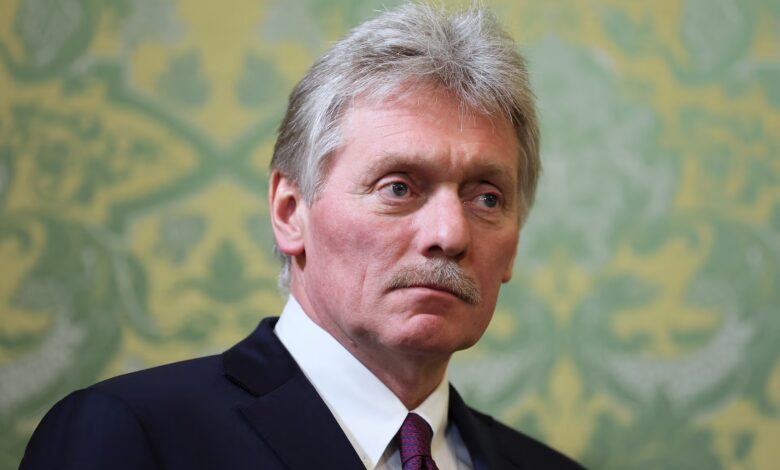
Russia said Monday that a U.S. blockade of the Strait of Hormuz will likely hurt global markets.
Asked to comment on the U.S. announcement of a blockade on Iran’s ports and coastline, Kremlin spokesman Dmitry Peskov said: “Most likely, such actions will continue to negatively impact international markets, this can be assumed with a high degree of certainty.”
Peskov told reporters: “Many details remain unclear and incomprehensible, so I would refrain from making any substantive comments at this time.”
Netanyahu spoke with Vance after Pakistan talks ended
Israel’s Prime Minister Benjamin Netanyahu said Monday that he has spoken with U.S. Vice President JD Vance about the negotiations in Pakistan.
Netanyahu said the pair spoke Sunday while Vance was on the plane returning from the negotiations in Islamabad.
Israel supports President Donald Trump’s “strong stance to impose a naval blockade on Iran,” Netanyahu said, adding that Israel backs the U.S. position that Iran must remove all of its enriched nuclear material and must refrain from any enrichment within Iran for several decades.
Iran and Saudi Arabia discuss Islamabad talks, Iranian media reports
Iran’s Foreign Minister Abbas Araghchi has spoken by phone with his Saudi counterpart, Prince Faisal bin Farhan, two Iranian semiofficial media outlets reported.
The ministers discussed the talks between the U.S. and Iran in Pakistan which failed to achieve a deal, Mehr News agency said, without elaborating further.
Israel strike on Hamas-run security point in Gaza kills 3
An Israeli airstrike killed at least three Palestinians in central Gaza Strip early Monday, hospital authorities said.
The strike hit a Hamas-manned security point just after midnight in the eastern part of Deir al-Balah city, in central Gaza, according to the Al-Aqsa Martyrs Hospital which received the dead men. One Palestinian was also wounded in the strike.
The military did not immediately respond to a request for comment.
The deaths were the latest among Palestinians in the coastal enclave since an October fragile ceasefire deal attempted to halt a more than two-year war between Israel and Hamas in Gaza. While the heaviest fighting has subsided, the shaky ceasefire has seen almost daily Israeli fire.
US and Iran appear ‘sincere’ over ceasefire, Turkey says
Turkish Foreign Minister Hakan Fidan has said the U.S.-Iran ceasefire could be extended for 45 to 60 days to allow the negotiations to continue.
Fidan, whose country has supported mediations efforts, said the U.S. and Iranian delegations presented initial “maximalist” positions during the talks in Pakistan, adding that Iran is expected to review U.S. proposals and respond.
“If the parties make good progress, an additional ceasefire could be introduced — lasting 45 to 60 days — so that negotiations can continue,” he said in an interview with state-run Anadolu Agency. He cautioned however, that Israel remains “a factor” that could disrupt the negotiations. The nuclear issue could also become a sticking point, he said.
“If the nuclear matter turns into an all‑or‑nothing situation, especially regarding enrichment, we could face a serious obstacle,” Fidan said. “But hopefully, with the support of mediators and other countries, we will try to overcome this as well.”
Union sounds alarm over crews stuck in Strait of Hormuz
A labor union said Monday that thousands of crew members stuck on vessels in and around the Strait of Hormuz are running short on basics and growing increasingly desperate.
Milind Kandalgaonkar, general secretary of the National Union of Seafarers of India, said that nearly 20,000 Indian crew members were stranded in the region.
“Many of these seafarers are reportedly facing acute shortages of food, potable water, and essential medical supplies,” he wrote in a letter to India’s national shipping board. He urged authorities to ensure supplies can reach the vessels, protect seafarers’ welfare and prepare evacuation plans if needed.
Tanker owners say the ceasefire has done little to ease conditions for mariners in the strait, where crews report dwindling food and fresh water.
US blockade of Iran could trigger Houthi disruption of Bab el-Mandeb, analyst warns
The U.S. blockade of Iranian ports could prompt the Iranian-backed Houthi rebels in Yemen to disrupt transit through Bab el-Mandeb Strait, an analyst has warned.
“If the U.S. moves to impose a blockade on Iranian ports and Iran starts feeling the pain, the Houthis are very likely to escalate in the Bab el-Mandeb,” said Ahmed Nagi, a senior analyst for Yemen at the International Crisis Group think-tank.
The closure of Bab el-Mandeb would add “another layer” of pressure on the global shipping industry, he said.
Germany’s Merz says U.S.-Iran peace talks in Pakistan were not well prepared

German Chancellor Friedrich Merz has criticized the peace talks between the U.S. and Iran in Pakistan last week as not well prepared.
“I was not surprised by the decision to break off the talks in Islamabad,” he told reporters in Berlin on Monday.
“From the very beginning, I didn’t get the impression that they were really well prepared,” the chancellor said without further elaborating who exactly he was referring to with this criticism.
Lebanese Red Cross offices in Tyre hit by drone
The offices of the Lebanese Red Cross in Tyre were hit by a drone strike on Monday, Lebanon’s state-run National News Agency reported.
The strike in the southern coastal city killed a wounded person being transported and damaged Red Cross vehicles. The Israeli military did not immediately reply to inquires from The Associated Press.
The funeral was being held on Monday for a Lebanese Red Cross volunteer killed on Sunday in an Israeli strike that hit his team while on a mission in Beit Yahoun.
The Lebanese Red Cross operates in war-torn southern Lebanon in coordination with the UN peacekeeping mission in Lebanon, UNIFIL, and the Lebanese military.
France, U.K. to convene talks on Hormuz navigation mission
France and the U.K. will organize a conference with partners ready to contribute to a peaceful multinational mission to help restore navigation in the Strait of Hormuz, President Emmanuel Macron said.
In a post on X, Macron stressed “the need to restore free and unimpeded navigation through the Strait of Hormuz as quickly as possible.” He called for a “peaceful multinational mission,” adding: “This strictly defensive mission, separate from the warring parties to the conflict, is intended to be deployed as soon as circumstances permit.”
France and the U.K. have in recent years been working to set up an operation that would allow ships to cross the Strait of Hormuz once the fighting ends.
Pope Leo hits back at Trump over Iran war
Pope Leo XIV said that the Vatican’s appeals for peace and reconciliation are rooted in the Gospel, and that he didn’t fear the Trump administration.
“To put my message on the same plane as what the president has attempted to do here, I think is not understanding what the message of the Gospel is,” Leo told The Associated Press aboard the papal plane. “And I’m sorry to hear that but I will continue on what I believe is the mission of the church in the world today.”
History’s first U.S.-born pope stressed that he was not making a direct attack against Trump or anyone else with his general appeal for peace and criticisms of the “delusion of omnipotence” that is fueling the Iran wars and other conflicts around the world.
Germany will reduce energy tax for diesel and gas for 2 months
The roughly 17-cent (20 U.S. cent) per-liter reduction is intended to help cushion the impact of high energy prices linked to the Iran war.
Chancellor Friedrich Merz said Monday the measure “will very quickly improve the situation for drivers and businesses across the country, and especially for those who spend a great deal of time on the road, primarily for work-related reasons.”
Source: AP news