Beyond Oil: Why Regional Conflict Is Becoming a Development and Financial Risk Story

Editor’s Opinion
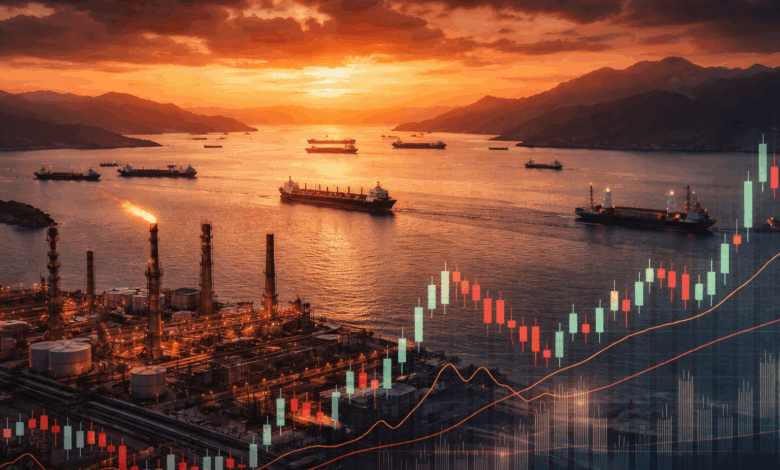
War in the Middle East is rarely contained to the battlefield. It moves quickly into shipping lanes, insurance costs, stock markets, fuel prices, investor sentiment and public spending priorities. That is what makes the current conflict so serious for the wider region. The immediate attention is on oil, and understandably so. The Strait of Hormuz carries about 20% of the world’s oil and LNG, and AP reported that the conflict pushed oil from below US$70 to near US$120 at one stage before prices eased back. Reuters also reported maritime war-risk premiums rising to around 3% of vessel value, up from roughly 0.25% before the conflict. For business leaders, that is the real warning sign. This is no longer only a security story. It is becoming a cost story, a confidence story and, increasingly, a development story.
For Gulf economies, the easy assumption is that higher oil prices soften the blow. That is only true up to a point. Higher hydrocarbon prices may support revenues in the short term, but they do not cancel out weaker tourism flows, more expensive trade, disrupted aviation, or markets spooked by instability. Reuters reported that Dubai’s main index fell more than 11% in four sessions, while a separate Reuters report put the potential hit to Middle East tourism at up to US$56 billion if the conflict continues to damage travel confidence. For economies such as the UAE and Saudi Arabia, which have spent years building a proposition around stability, connectivity, tourism and global capital, that matters far more than one oil-price spike. The region’s diversification story depends on confidence. Once confidence slips, growth becomes harder to protect.
That pressure is even more severe for countries with less fiscal room. Reuters reported on 10 March that Egypt raised domestic fuel prices by 14% to 17% as global energy turbulence fed through to the local market. For households, that shows up immediately in transport costs and everyday spending. For businesses, it feeds into logistics, operations and already fragile consumer demand. The IMF has already warned that total gross public financing needs for MENA emerging market and middle-income economies plus Pakistan are projected to rise to US$263 billion in 2025, up from US$249 billion in 2024, before reaching US$303 billion by 2029. Add conflict-driven borrowing pressure and investor caution to that mix, and the financial strain becomes much more than temporary noise.
This is where the human-development piece becomes a business issue, not a separate humanitarian chapter. When conflict disrupts education, health access, labour mobility and family stability, it damages the region’s future productivity. UNICEF says 30 million children are already out of school across the Middle East and North Africa, equal to roughly 1 in 3 children across 12 countries. That is not just a social tragedy. It is a warning about weakened human capital in a region that is trying to compete on innovation, services, technology and higher-value growth. If more families are displaced, more schooling is interrupted and more public budgets are forced into emergency response, the long-term cost will be paid in lower productivity, weaker job readiness and slower development. UNDP has already said this war is likely to reverse hard-won social and economic gains across the region.
The latest displacement figures show how quickly that erosion can happen. Reuters reported on 9 March that nearly 700,000 people had been uprooted in Lebanon in just over a week, including around 200,000 children. Once displacement reaches that scale, the commercial impact spreads well beyond humanitarian agencies. Labour markets become less stable, informal economies grow, schools and clinics struggle to function, and host communities face new pressure on already stretched services. There is also a quieter cost that does not show up immediately in market dashboards. UNICEF estimates that 1 in 6 adolescents in MENA lives with a mental health disorder, and conflict only deepens that burden. A region cannot talk seriously about resilience, competitiveness or future readiness while normalising repeated shocks to the wellbeing of its youngest population.
None of this means the Gulf is entering the crisis without buffers. The IMF has said the UAE has shown resilience to global uncertainty, regional conflict and volatile oil prices, supported by diversification and non-oil growth. That matters, and it offers some reassurance. Still, resilience should not be mistaken for insulation. Reuters has already reported two-day trading suspensions in the UAE, extraordinary market measures to manage volatility, and a growing test of Dubai’s safe-haven appeal. When investors begin to ask whether capital, operations and talent can move as freely and safely as before, the economic question changes. It is no longer about whether the region can absorb a shock. It becomes about whether it can preserve momentum.
That is why the most important business question is not what oil does next week. It is whether this conflict hardens into a wider pattern of uncertainty that changes how the region is priced, insured, financed and trusted. If shipping stays vulnerable, if tourism weakens, if market volatility lingers and if governments are pushed to reallocate spending away from development and toward crisis management, the bill will extend far beyond energy. It will show up in delayed projects, more expensive capital, slower hiring, strained public finances and softer long-term growth. The Middle East has spent years trying to convince global investors that it is not defined by conflict. The danger now is that conflict starts re-entering the region’s valuation from every direction at once.